The 2026 Solar Charging Revolution: From Portable Gadgets to Smart Grid Assets
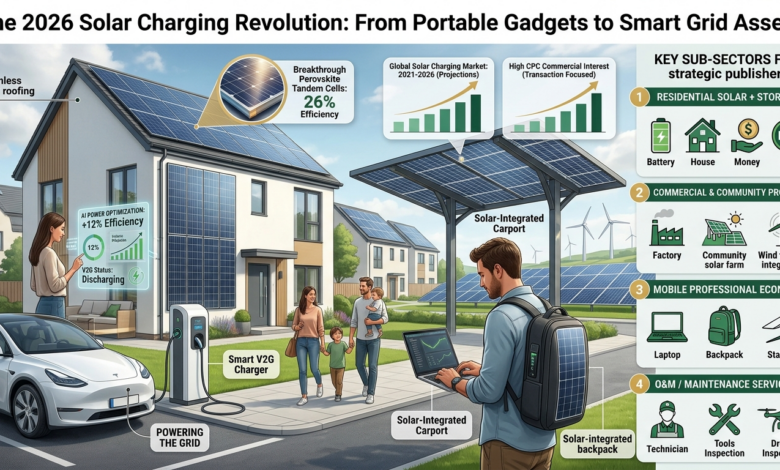
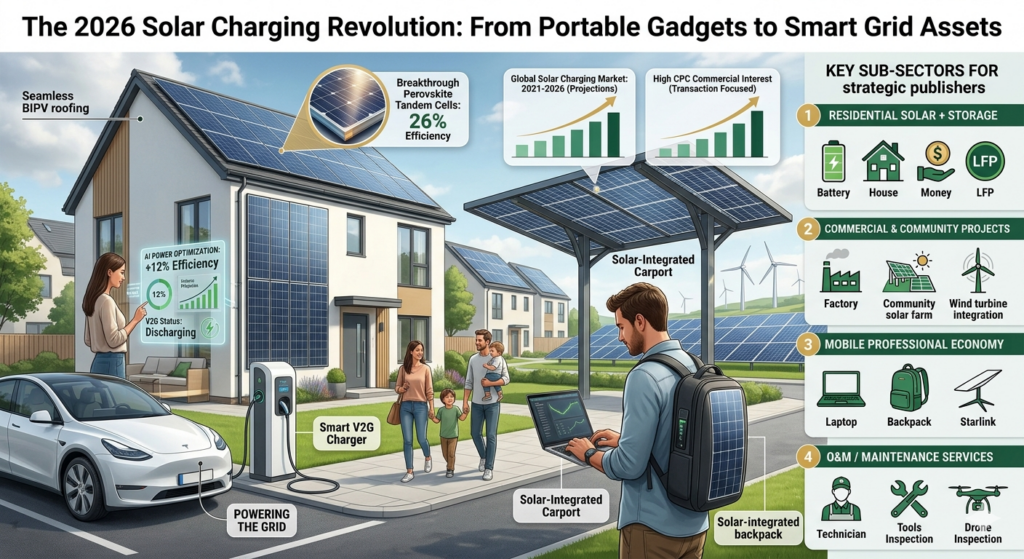
As we move through 2026, the definition of a “solar charger” has expanded far beyond simple phone banks. It is now the foundation of a decentralized, sustainable lifestyle. Driven by breakthrough efficiencies and falling battery costs, solar charging technology is now a critical infrastructure for the modern home and mobile professional.
1. Breakthrough Perovskite and Tandem Cell Efficiency
The most significant technological leap in 2026 is the commercialization of perovskite-silicon tandem cells. Unlike traditional silicon-only panels, these tandem architectures capture a broader spectrum of sunlight, with commercial modules now routinely hitting 24-28% efficiency.
- Why it’s High CPC: Advertisers in this sub-niche include specialized R&D firms and high-end installers targeting consumers who want maximum output from limited roof or vehicle space.
- Market Impact: UK-based companies like Oxford PV have already begun shipping these modules, offering 15-25% more electricity from the same footprint as standard panels.
2. The Rise of “Solar and Storage” Hybrid Systems
In 2026, the market has pivoted from standalone panels to integrated Solar + Battery Storage solutions. With battery prices hitting record lows—around $70/kWh—homeowners are increasingly adopting onsite storage to power EV chargers and smart homes during peak utility pricing.
- Key Trend: Lithium Iron Phosphate (LFP) has become the dominant chemistry for residential storage due to its superior safety and longevity, often lasting over 6,000 cycles.
- High CPC Keywords: LFP solar battery storage solutions, V2G (Vehicle-to-Grid) home integration, best smart solar inverters 2026.
3. Solar for the “Digital Nomad” and Mobile Economy
The surge in remote work has fueled a massive demand for high-performance portable solar charging for laptops, Starlink systems, and RVs.
- Bifacial Technology: Once exclusive to solar farms, bifacial panels—which capture light from both sides—are now common on flat commercial roofs and solar carports, providing a 5% to 20% energy production boost.
- Affiliate Opportunity: This sector is lucrative for creators reviewing high-wattage foldable panels (100W+) and modular power stations.
4. AI-Powered Energy Optimization
The “smart” solar charger of 2026 uses AI-driven monitoring to maximize efficiency. These systems use pattern recognition to predict failures and adjust output at the panel level to minimize losses from shading or dust.
- Efficiency Gains: AI optimization can deliver an additional 5-15% gain in usable energy without adding new hardware.